February 19, 2026
Natural Cleaning Products That Actually Work (and Where They Don’t)
Most natural cleaning products sold in Canada can be replaced by five things: citric acid, white vinegar, baking soda, castile soap, and one enzyme product for anything biological. Each belongs on a particular surface, though, and the vinegar that dissolves a limescale ring will permanently etch marble. Here is the working set and its limits.
Citric acid does the work vinegar gets credit for
Citric acid is a white food-grade powder, and the most useful of the natural cleaning products sold in Canada. A tablespoon in 500 ml of warm water dissolves the calcium and magnesium that showers, kettles and taps collect: the ring in a toilet bowl, the film on shower glass, the crust at a tap base, the rust bleed under a dripping faucet.
The reason to choose it over vinegar is control. Vinegar arrives at a fixed strength, usually about 5 per cent acetic acid, and cleaning vinegar is stronger still, which is exactly what you do not want near stone. A powder lets you mix weak for a daily spray and strong for a shower head soaked overnight in a tied bag. Rinse and dry afterwards, or the residue dries tacky.
Vinegar is a good acid and a bad habit on stone
White vinegar is cheap, cuts light grease, lifts soap scum off tile, and leaves glass clear if you buff it dry. Its reputation is oversold. At bottle strength it slows some organisms and does very little to others, so when a job needs disinfection, buy a product labelled for that and read the contact time. Vinegar is a descaler, and a good one. Trouble starts when it is treated as universal.
Where acid causes permanent damage
Marble, travertine and limestone are calcium-based stone, so the acid reacts with the stone and not just the dirt. A splash left for a minute dulls the polish; a weekly spray leaves white etch marks that no cleaner will remove. Cement grout is next: one scrub is harmless, but repeated acid eats the binder until the grout sheds sand. Vinegar also pits aluminium, strips the seasoning off cast iron, dulls waxed wood, and can damage the anti-glare coating on a screen.
Not sure a counter is real stone? Put a drop of vinegar behind the toaster for a minute. Marble fizzes faintly and the spot goes dull.
Baking soda and castile soap: two good tools, two bad habits
Baking soda is an abrasive, not a deodoriser
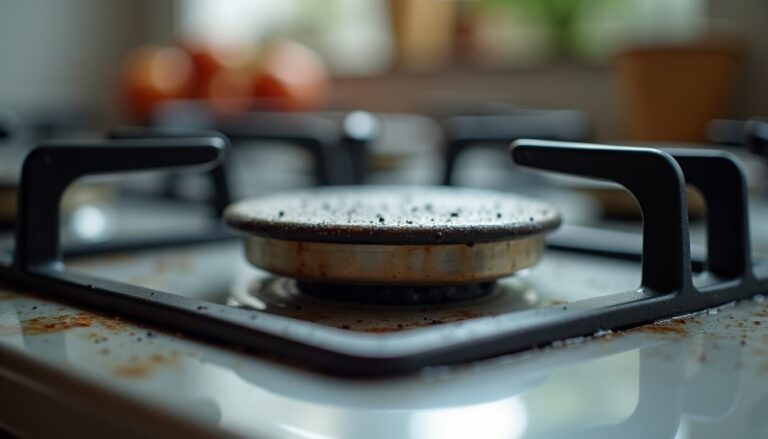
Sodium bicarbonate is a soft abrasive and a base, so a paste of three parts soda to one part water lifts burnt-on stovetop rings and tea stains without scratching enamel. It is not a deodoriser: a box in the fridge only affects air touching its surface, and soap removes the residue that holds the smell.
Castile soap works here because the water is soft
Castile soap is real soap, saponified vegetable oil rather than a synthetic detergent, and a teaspoon in 500 ml of warm water does counters, painted wood and cupboard fronts. Vancouver water is soft, drawn from the North Shore reservoirs, so it lathers easily and rinses clean. In hard water the calcium binds it into scum, which is why the same recipe hazes a counter elsewhere. Keep it off glass, where it films, and never add vinegar: the acid splits the soap into curds.
Enzymes are the only cleaners that break a mess down
Protease, amylase and lipase digest protein, starch and fat instead of lifting or dissolving them, and nothing else on a natural shelf does that. They are the right answer for pet accidents on carpet, milk in a car seat, the drain line under a kitchen sink, a front-load washer seal, and the bin cupboard that smells however often it is wiped.
Two rules. Give them dwell time: spray, walk away for ten minutes, because scrubbing straight away wastes the product. Keep heat and bleach away, since hot water denatures the enzymes and bleach destroys them. On carpet, blot first, apply, then leave it damp rather than soaked. Enzymes are not disinfectants, and they will not fix a smell coming from a damp wall.
Surface, product, and what to keep off it
Worth taping inside a cupboard door.
| Surface | What works | What to avoid |
|---|---|---|
| Marble, travertine, limestone | pH-neutral stone soap | Vinegar, citric acid, soda paste |
| Ceramic tile, sealed grout | Warm water, neutral cleaner | Repeated acid soaks |
| Glass, mirrors | Equal parts vinegar and water | Castile soap, paper towel |
| Stainless steel | Microfibre, wiped with the grain | Soda paste |
| Wood and engineered floors | Neutral cleaner, mop wrung nearly dry | Vinegar, castile soap |
| Toilets, kettles, shower heads | Citric acid soak | Bleach on a mineral ring |
| Oven interior | Soda paste, left overnight | Acid on the door seal |
| Cast iron, aluminium | Hot water, a little dish soap | Vinegar on iron, soda on aluminium |
| Carpet, pet accidents | Enzyme cleaner, left damp | Steam or hot water |
| Drains | Enzyme treatment | Soda-and-vinegar volcano |
| Screens and electronics | Dry microfibre only | Any spray |
Recipes that work, and what not to mix
Three mixes worth making
- All-purpose: 1 teaspoon castile soap in 500 ml warm water, for counters and cupboard fronts. Wipe with a clean damp cloth after; dried soap is what makes a surface sticky.
- Glass and chrome: equal parts white vinegar and water, buffed dry in one direction so you can see what you missed.
- Limescale and soap scum: 1 tablespoon citric acid in 500 ml warm water. Five minutes, a brush, then a rinse.
Write what is in every bottle. A refilled spray labelled bleach, holding vinegar, is how people end up coughing in a stairwell.
What not to mix
- Bleach and ammonia, which produces a toxic gas.
- Bleach and any acid, vinegar or citric included. Same problem, faster.
- Bleach and hydrogen peroxide, in a bottle or on one surface.
- Vinegar and hydrogen peroxide in one bottle; more irritating than either alone.
- Vinegar and castile soap, which curdle the soap and clean nothing.
- Baking soda and vinegar in a sealed container: they neutralise each other and build pressure.
Vancouver grime is a specific problem
Soft water is the good news. Soap lathers, rinses clean and leaves no film, so a castile mix and a microfibre cloth cover most of a bathroom here. The bad news walks in from October to March. Road salt and grit on the entry tile settle into grout and carpet edge, and a wet mop pushes salt into a haze that dries white. Vacuum first, then mop, then rinse the mop.
Older character homes in Mount Pleasant and Kits have fir floors with a wax finish that vinegar strips over a season, single-pane windows that grow mould in the corners, and radiator fins that hold dust. Rentals add carpet and an exhaust fan wired to the light switch, so the bathroom stays damp and the black film in the corner is soap scum plus mould. No spray fixes ventilation. If the place needs more than a surface reset, that is a deep clean, not a better bottle.
What it costs in Vancouver
Mixing your own is cheap in ingredients and expensive in hours. A bag of citric acid, a jug of vinegar, a box of soda, castile soap and an enzyme concentrate cover an apartment for months. What they do not cover is the four hours a first deep clean takes.
The published prices, for comparison: recurring home cleaning from $119 for a one-bedroom, one-bathroom to $179 for four or more bedrooms, about two hours a visit. A home deep clean is $349 to $549 and runs about four hours. Move-out and possession day is $329 to $549. Listing prep is $249. Commercial and strata work is quoted after a walkthrough. Flat rate, shown before you book, paid after the clean. If you would rather hold a standard than a shelf of bottles, recurring house cleaning is the cheaper habit.
Frequently asked questions
Is vinegar a disinfectant?
Not in the sense most people mean. It is a descaler with mild antimicrobial action that depends on strength and contact time, neither of which a spray-and-wipe delivers.
Can I use one spray on every surface?
No, and the exceptions are the expensive ones: natural stone, waxed wood, aluminium, cast iron and screens. A neutral soap spray is the closest to universal, and even that needs rinsing on stone and glass.
Do natural cleaners need to be rinsed?
Soap-based ones do, or they dry sticky and pull dust. Acid sprays need rinsing on anything porous, including grout, because the residue keeps working after you leave. On glass, buffing dry is the rinse.
Would rather not mix anything? Framework Property Care cleans homes across Vancouver, flat-rate from $119, using biodegradable products and colour-coded microfibre so bathroom cloths never reach a kitchen counter. Book a clean or call 604-966-3882. How the team works is on the about page.
Related guides
More on this topic from our Vancouver cleaning team.