
January 20, 2026
Effective Strategies for Removing Kitchen Grease in Vancouver Homes
Grease does not come off because you scrubbed harder. It comes off because the right product was given time to break the bond, then lifted onto a cloth instead of spread around. Here is the degreasing sequence and how to treat each kitchen surface without damaging it.
Why soap smears grease instead of lifting it
Cooking grease is oil-based. Water is not. Dish soap bridges the two: one end of the molecule grabs oil, the other grabs water, which is why a soapy cloth does eventually work. But it only works with dwell time and enough warm water to carry the oil away. Wipe a greasy surface with a damp cloth and you dilute the film and push it over a larger area. It dries tacky, and the next week of dust sticks to it.
The second mistake is volume. More product does not remove more grease. Every extra drop leaves a residue that grabs dust, and on a dark counter it shows as a haze within days. The fix is almost always less product, longer dwell, and a clean rinse.
The degreasing sequence that works
Order matters more than strength. Work from the highest greasy surface down, so drips do not run onto cabinets you have already cleaned.
- Take the loose material off dry. Crumbs, dust, pet hair. Wetting dust turns it into a paste you then have to chase.
- Test in a hidden spot. Under the cabinet, the side of the fridge. Wipe a small area, wait a minute, and look for dulling or colour lift.
- Start high. Hood, the wall above the stove, the tops of the upper cabinets, then down to the backsplash and cabinet fronts.
- Apply degreaser and leave it three to five minutes. Keep it wet. If it dries it stops working, and the dried film is harder to rinse than the grease was.
- Agitate. A non-scratch pad on flat surfaces, a stiff brush in grout, and always along the grain on stainless steel.
- Lift, do not scrub. One pass, one clean face of the cloth. Fold microfibre into quarters and turn it as it loads.
- Rinse with clean water and a second cloth. This is the step people skip, and the reason a kitchen looks dull a week later.
- Dry. Air-dried degreaser leaves streaks on dark stone and on stainless.
Surface by surface
Painted and thermofoil cabinets
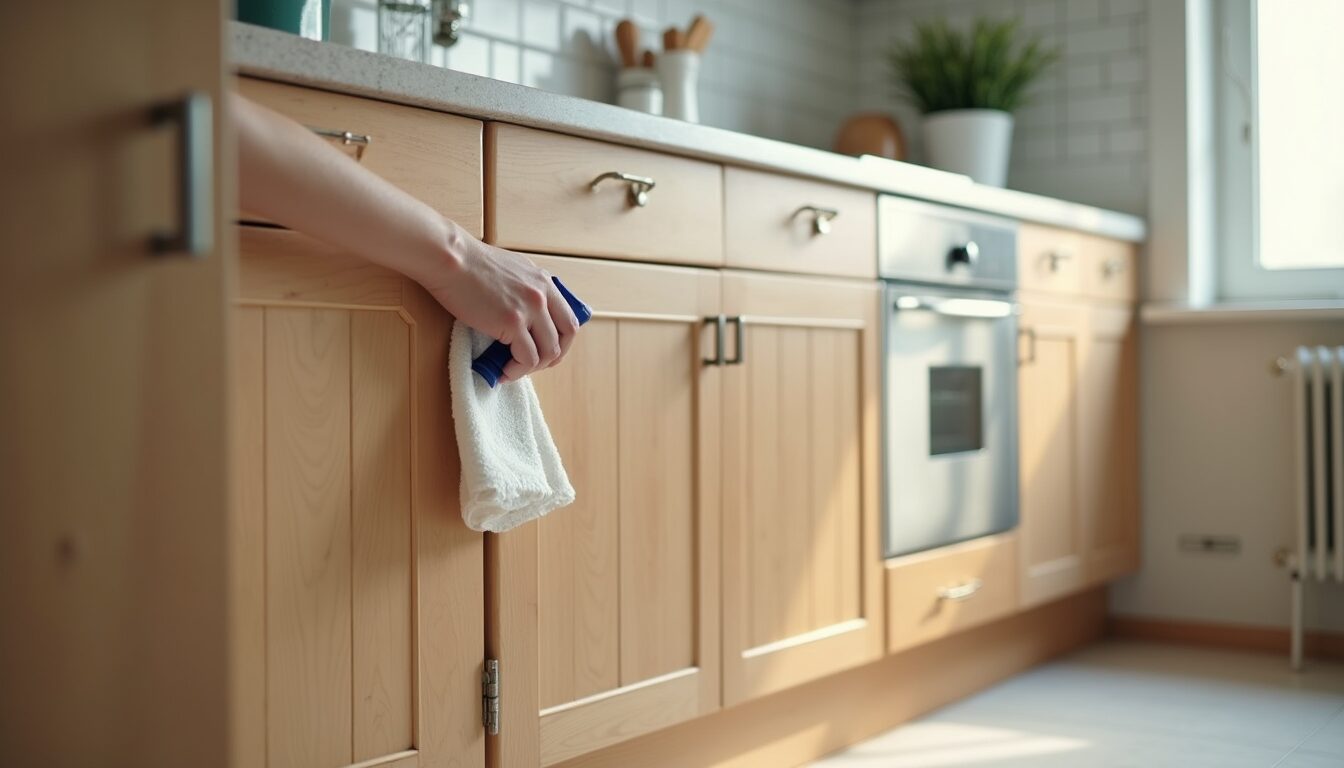
Grease collects on the bottom edge of upper doors and around the handles, where hands land. Spray the cloth, not the cabinet. Spray runs down the face, sits in the seam at the bottom, and swells the MDF behind the paint. On thermofoil, a soaked seam is how the film starts peeling. Skip the melamine sponges on satin or matte finishes; they are mildly abrasive and leave a dull patch that catches the light.
Quartz, granite, and laminate
Quartz is resin-bound. No vinegar, no lemon, no bleach, no abrasive powder, and no hot pan straight off the burner. Warm water with a drop of dish soap is enough. A haze on quartz is usually product residue rather than damage, and rinsing it fixes it. Sealed granite tolerates more, but acidic cleaners dull the sealer, so use a pH-neutral stone soap and dry the surface instead of letting it air-dry with water rings. Laminate is the forgiving one, with a caveat: never flood a seam.
Stainless steel and glass
Wipe with the grain, never in circles, or you trade a grease film for visible swirls. Chlorine-based cleaners pit stainless. A damp cloth followed by a dry one is usually all it needs; a thin stainless polish goes on after, not instead. On a glass cooktop, soften a burnt ring with soapy water, then use a razor blade at a shallow angle with the glass wet. Scraping dry is how cooktops get scratched.
Grout and silicone
Baking soda paste, ten minutes, a toothbrush, then rinse and dry. Keep acid off natural stone tile, where it etches the face. If the black spotting is inside the silicone bead rather than on it, cleaning will not fix it. That is a re-caulk job, and a small one.
| Stain | Method | Avoid |
|---|---|---|
| Cabinet film above the stove | Alkaline degreaser, five minutes, damp cloth, dry | Abrasive pads, melamine sponges |
| Baked ring on a glass cooktop | Soapy water, razor at a shallow angle | Dry scraping, steel wool |
| Haze on quartz | Warm water and a drop of dish soap, then rinse | Vinegar, bleach, abrasive cream |
| Dull patch on granite | pH-neutral stone soap, buff dry | Acidic cleaners, lemon juice |
| Fingerprints on stainless | Damp cloth with the grain, dry, thin polish | Chlorine, circular wiping |
| Grease on a painted cabinet edge | Degreaser on the cloth, light pressure | Spraying the seam, soaking it |
| Hood filter | Hot water and degreaser, twenty-minute soak | Relying on the dishwasher alone |
| Grease on a shirt | Dish soap worked in, then a cool wash | Hot water first, which sets it |
What Vancouver kitchens add
Our water is soft, so degreaser rinses easily and soap lathers more than you expect. The common result is a kitchen cleaned with twice the product it needed, which leaves a film that dust sticks to. Use less here than the bottle says.
Humid air for most of the year keeps grease tacky longer, so the rinse and dry steps matter more in Vancouver than in a dry climate. If your range hood recirculates through a filter instead of venting outside, which is common in Vancouver condos, that filter is doing all the work and needs washing monthly rather than yearly. In an open-plan apartment you can see where the grease goes: the top of the fridge, the upper cabinet faces, and a film on the television screen. A ceiling that feels slightly tacky above the stove is the other tell.
When it is worth calling someone
A weekly wipe handles a kitchen that gets cooked in. Call for help when the grease has moved into places a cloth cannot reach: the hood, the gap between counter and backsplash, the oven door glass, the tops of the cabinets, and grout that has gone from grey to brown. Those are also the slowest jobs, which is why they get postponed.
Our deep clean covers the kitchen as a whole rather than the visible surfaces, and the room-by-room order is on the deep cleaning checklist if you would rather work through it yourself over a weekend.
What it costs in Vancouver
A deep clean that includes the kitchen properly runs $349 to $549 and takes about four hours, quoted flat before the visit. A recurring clean from $119 to $179 keeps the kitchen from getting back to that point, at roughly two hours a visit. Payment is after the clean, and anything missed on the agreed list is re-done within 48 hours.
Compare that with the products alone: a degreaser, a stone-safe cleaner, a stainless polish, and a pack of microfibre cloths is most of the way to a recurring visit, and it still leaves you the four hours.
Frequently asked questions
Is vinegar good for kitchen grease?
Not on its own. Vinegar is acidic and cuts mineral film and light soap residue, but grease needs an alkaline degreaser and dwell time. Vinegar is also the wrong choice on quartz, granite, and any natural stone, where it dulls the surface.
How often should a kitchen be degreased rather than wiped?
Every three to four months for a kitchen cooked in daily, and monthly for the hood filter if it recirculates. If the cabinet fronts feel tacky in summer, it is already due.
Can a kitchen be cleaned without harsh chemicals?
Yes, and it is what we use: biodegradable degreasers, hot water, microfibre, and dwell time instead of strength. Bathroom cloths never touch kitchen surfaces, which is why our cloths are colour-coded.
Rather not spend a Saturday on it? Framework Property Care cleans kitchens and homes across 32 Vancouver neighbourhoods, flat-rate from $119. Book a clean or call 604-966-3882.
Related guides
More on this topic from our Vancouver cleaning team.